Reagent storage
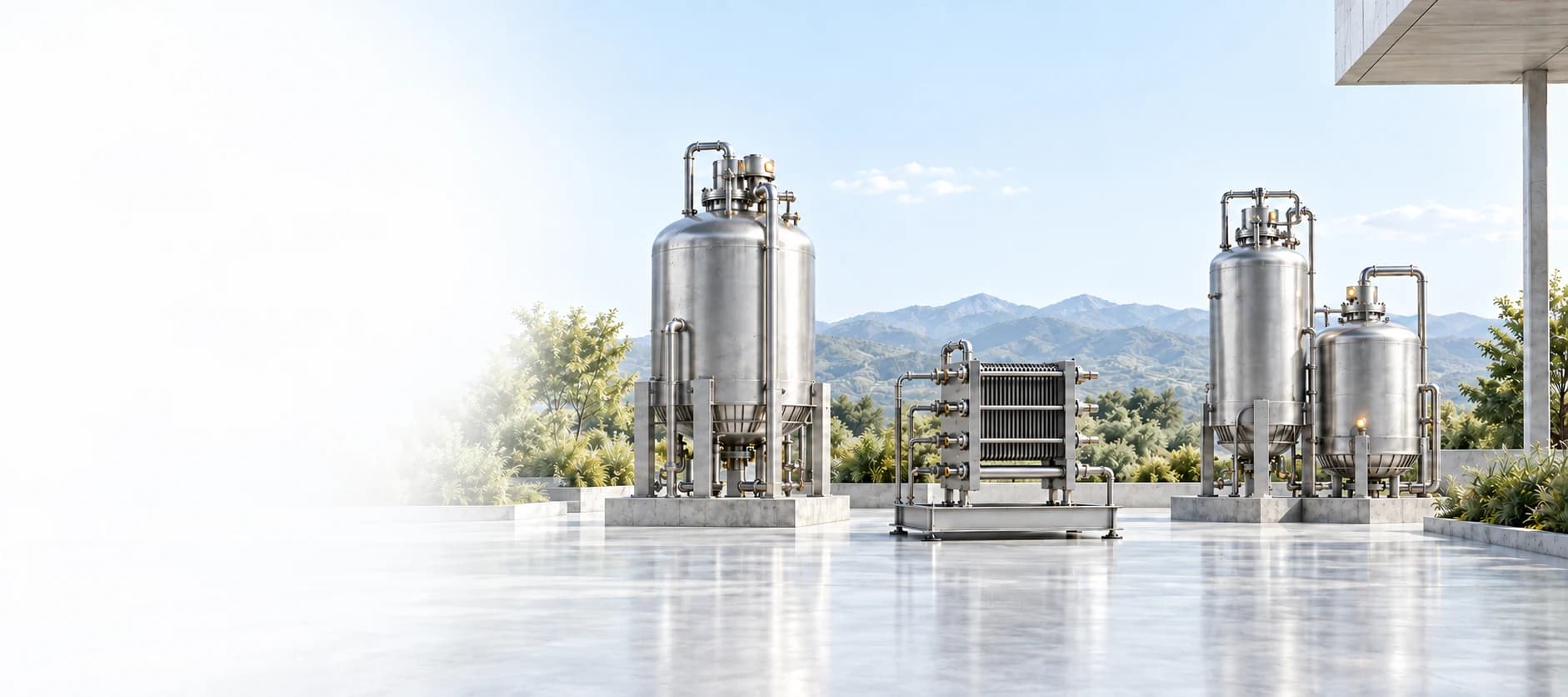
Purpose-designed vessels hold the combined and separated material states.
SuperFuel systems
Reagent storage, electrochemical stacks, and supporting systems—configured for the application.
Illustrative development configuration
Scroll to exploreOperating principle
Charging separates sodium nitrite into sodium and nitrogen dioxide, storing electrical energy in the separated reagents.
Reversible cycle
Charging stores electrical energy in separated reagents. Discharging reverses the reaction and returns electricity to the system.
SuperFuel battery
The storage vessels, electrochemical stack, thermal management, power electronics, and control systems operate as one configurable machine.
Purpose-designed vessels hold the combined and separated material states.
Series-connected electrochemical cells establish the system voltage architecture.
Application-specific equipment maintains the required operating states.
Grid-facing electronics convert, condition, and route electrical power.
Isolation, monitoring, and supervisory control coordinate safe system operation.
Independent scaling
Each planar cell contributes to the series stack. Add cells to change the voltage architecture without adding stored reagent. Increase reagent volume to add stored energy without changing the series stack.
Battery landscape
SuperFuel retains the external-storage logic of a flow battery while using a different energy-bearing material. This architectural view shows where it sits beside established and emerging battery families.
Three tanks hold sodium nitrite (NaNO₂), sodium (Na), and nitrogen dioxide (NO₂), each connected to a planar electrochemical stack.
| System characteristic | Lithium-ion | Sodium-ion | Vanadium flow | SuperFuel RIFB |
|---|---|---|---|---|
| System format | Sealed cell modules | Sealed cell modules | Pumped tanks + cell stack | Three reagent tanks + cell stack |
| Where energy is held | Electrode materials inside each cell | Electrode materials inside each cell | Dissolved vanadium ions in external electrolyte | Separated sodium and nitrogen-dioxide reagents |
| Power and energy scaling | Generally coupled at the module level | Generally coupled at the module level | Independently sized | Independently sized |
| Principal chemistry inputs | Lithium + cathode-dependent materials | Sodium + cathode-dependent materials | Vanadium in aqueous electrolyte | Sodium · nitrogen · oxygen |
| Commercial maturity | Established at global scale | Early commercial scale-up | Commercially deployed | Development-stage system |
Representative architectural and material-level comparison—not a claim of equivalent packaged-system performance. Formulations, system boundaries, operating conditions, and commercial configurations vary by supplier and application.
Design logic
Increasing material storage does not require rebuilding every electrochemical cell.
The planar stack can be configured around the electrical requirements of the application.
Stored-energy duration can grow through external vessel capacity rather than a fixed battery enclosure.
Next / The SuperFuel network
See how distributed production, transport, and the Infinite Well can connect renewable generation with continuous demand.
Explore the network